One of the most prominent legends associated with Kubera is his acquisition of wealth and his rise to power.
Lord Kubera Temples:
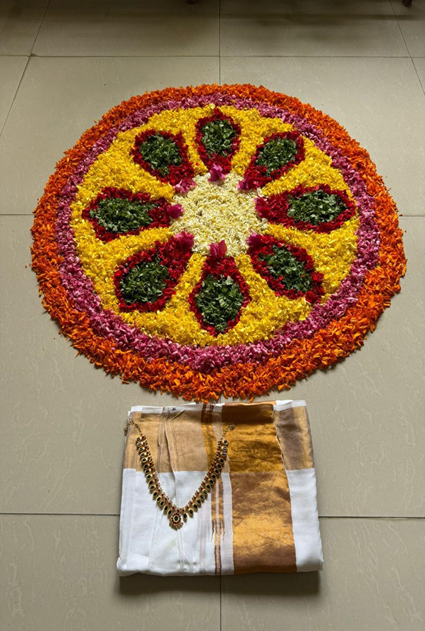
Pookkalam ( Floral Rangoli ) is one of the most prominent aspects of the Onam festival. It’s the creation of intricate and colorful designs, Malayalees decorate at the entrances of their homes with beautiful patterns made from various types of flowers. Each day of the festival, the size and complexity of the Pookkalam increase, reaching its pinnacle on the tenth and final day ending with Onam.
Pookkalams showcase rich social and cultural heritage and hold significant symbolism, in addition to their captivating beauty. Its design conveys the DNA it shares with other floral designs found in other parts of India like rangoli carpets, showcasing its rich historical heritage. Furthermore, Pookalams are followed by the cleaning of homes, they bring together multiple people, and are also symbolic of being one with nature – therefore, it is heavily associated with the prosperity, sanctity, and harmony of families and the community as a whole.
The tradition of laying the Onam Pookalam (floral carpet) begins, marked by Atham Nakshatram in the month of Chingam on the Malayalam calendar. ( Chingam 21, this year 1200 on the Malayalam calendar), and culminates on the 10th day of Tiruvonam. This year Onam is celebrated between the 6th to 15th of September 2024.
Day 1: Kashumala**
The first day’s floral design marked by Atham Nakshatra is inspired by the Kashumala necklace, a cherished piece of jewelry symbolizing grace and heritage passed down through generations.
Kashumala is believed to represent Goddess Lakshmi, the
goddess of wealth, prosperity, and good fortune. "Kashu" refers to
the gold coins used to craft the necklace.
Day 2: Mani Mala**
On the second day of Onam, marked by Chithra Nakshatra the Pookkalam (floral carpet) is offered in reverence to Lord Ganesha on the auspicious occasion of Ganesh Chaturthi.
The featured jewelry is the Mani Mala, a simple yet elegant necklace made of gold ball-shaped beads. Traditionally worn by women in Kerala, this timeless piece adds grace to everyday attire, symbolizing beauty in simplicity. In Pookkalam, the Mani Mala is displayed as the crown of Lord Ganapathy.
Day 3 : Pathakkam / Addil*
The third day of Onam festivities falls on Chothi Nakshatram and Pookkalam is themed on another traditional necklace called Pathakkam or Addil.
Addil is a traditional necklace women wear in Kerala, especially during important cultural and religious occasions.
The Addil typically consists of a central pendant
known as the "Pathakkam", which is often large and intricately
designed, surrounded by a chain of smaller gold or gem-encrusted elements.
Day 4 : Thalikkoottam
Vishakham Nakshatram falls on Day 4 of the Onam festivities. Pookkalam (floral carpet) is laid with local flowers that are traditionally plucked from the wild during the Onam season. The flowers used today are Chembarathi (hibiscus), thechi (Ixora), chembakam (frangipani), and manja arali (yellow bell flower). To suit this local practice, a very traditional ornament called Thalikoottam is presented.. Thali means the Mangalsutra pendant and Koottam means grouping. Thalikoottam thus means a necklace formed by a group of Thalis strung together to form an exquisite piece of jewelry. The Thalikoottam is displayed in an Uruli (traditional brass round bowl).
Day 5: Jhimikki*
Anizham Nakshatram marks the fifth day of Onam celebrations.
Pookkalam is themed around *Jhimikki* (also known as *Jhumka* in Hindi), a beloved piece of traditional jewelry. Fun fact: the *Jhimikki* gained widespread fame through the popular song "Ente Ammede Jhimikki Kammal" (My Mother’s Jhimikki Earring)! ๐
A *Jhimikki* is a traditional Indian earring, often
large, ornate, and dangling. These earrings are typically worn by Malayali
women as part of traditional South Indian attire. They come in various designs
and are commonly crafted from gold, silver, or other metals, often embellished
with gemstones or pearls.
Day 6: Nagapadam*
Triketta Nakshatram marks the sixth day of the grand Onam celebration. As the festival draws closer to its culmination, Kerala is filled with a palpable sense of joy and jubilation.
*Pookkalam* (floral carpet) features the iconic *Nagapadam* necklace, a traditional piece of jewelry often paired with the classic off-white and gold *Mundu Veshti*( Traditional Kerala Dress ).. This lovely combination takes center stage in the floral design symbolizing the deep-rooted traditions of Kerala.
The *Nagapadam* derives its name from the serpent’s hood
(*naga*), with the centerpiece shaped like a cobra’s hood, representing protection
and power. Adorned with green gemstones, this exquisite necklace is typically
worn during special occasions, signifying auspiciousness and prosperity.
Day 7: Palakka*
Moolam Nakshatram marks the seventh day of the 10-day Onam festival, a day rich in tradition and devotion.
Showcased here is the Palakka necklace, famously worn by Baby Krishna, or Unnikannan, the revered deity of Guruvayur.
According to folklore, the origins of Palakka jewelry trace back to the Dwapara Yuga, when Lord Krishna walked the earth. The design is believed to be inspired by the Pala tree (Milkwood Pine), with the necklace’s signature leaf-shaped motifs resembling the tree’s leaves.
The highlight is the Vyaali Palakka, where the mythical
Vyaali—an emblem of power and protection—takes center stage. This fierce,
lion-like figure is intricately carved and embossed into the heart of the
Palakka design, making it both a symbol of beauty and strength.
Day 8: Mullamottu*
The eighth day of Onam, marked by the Pooradam Nakshatram, is when King Mahabali is traditionally invited to visit the homes of his people.
For this day’s Pookkalam (floral carpet), the theme is inspired by the Mullamottu Mala (which means "Jasmine Buds Garland"). The jasmine buds, represented by white flowers, symbolize purity and simplicity and are central to today's floral design.
A "Mullamottu Necklace" refers to a jewelry design inspired by the arrangement of jasmine buds in a garland-like fashion. Known for its intricate craftsmanship, this design mirrors the delicate and graceful appearance of jasmine flowers, offering a blend of elegance and natural beauty.
Day 9: Navaratna Mothiram (Ring)*
Uthradam is the ninth day of the 10-day Onam festival known as the Onam Eve. It is a day of preparation for the grand Onam festival, for the last day.
Today's Pookkalam is inspired by the Navaratna Mothiram, believed to bring four-fold blessings: Dharma, Artha, Kama, and Moksha. According to Vedic astrology, women wear the ring on their left hand, and men on their right.
The Navaratna Mothiram features nine gems,
each representing a celestial body in Vedic astrology, and is said to bring
good fortune and balance planetary energies.
Onam 2024 – Day 10 – Thiruvonam is the
last day of the 10-day Onam festival which culminates on Thiruvonam Nakshatram
on the Malayalam calendar. A few traditional pieces like Poothali, Ilakkathali, Puliyamothiram, and Kazhuthila are missed here. On Thiruvonam a traditional Pookkalam with the Thrikkakkara Appan deity in the
centre. Thrikkakara Appan is the presiding deity at the famous Thrikkakara
temple in Ernakulam, which is closely associated with Onam. It is believed that
Vamana had sent Mahabali to this place where the holy feet (Trikkaal) of Maha Vishnu
were touched – and thus this spot.
Staying True to the Path: A Spiritual Journey
A young man on a righteous mission recently sought clarification from his Guru.
Question: We were a group of young people involved in a spiritual mission. Some of them have left us for some reason. Not only have they left, but they are also working against us.
What should we do? To do nothing in return?
Answer: Suppose it is raining in the morning when you need to go home in an emergency. You take an umbrella and continue your journey, right? That's all you need to think. No goal comes easily. If we accept this, it means we are lost or our goal is not true.
Therefore, when going on important missions, we should focus on something other than who is with us but focus on being true to ourselves rather than straying from our goal. Always look within and be convinced that you are on the right path with God.
Q: Swamiji, those who left were so necessary. But the problem is, how can you work against them?
A: No one is separated from anyone. It is only that all are established in Him. Even if a horse has run a long distance to take us to our destination, if we have to cross a river on the way, it cannot run through water. It doesn't matter if it's misquoted or misrepresented. If we force ourselves to enter the water, it will happen to us. Is it okay to ask how can you behave like this after being with me for so long? It doesn't even understand your language. Gratefully leaving it to graze on the river bank, the traveler finds a boat or swims across to the other side.
The registration fee for tug of war is the same as for the conflict in our minds. If there is a conflict, we have paid the fee for the tug-of-war competition. If you pull the rope, you will win, expending all your energy, leaving no spare time to walk towards the goal. So let go of enmity.
God is the source of goodness for everyone. If someone claims to have separated from you, it's best to let go and move forward. Just like a tug-of-war rope, if no one is on the other side pulling, there's no reason to continue holding on. Each person can live their life independently and in their own way.
Q: Swamiji suggests that we should proceed while thinking of Bhagavan.
A: Once they realize that we are correct, won't they come with us? Our way is the right way. Whoever reaches the goal is right. It is to be measured in the final reckoning. Leave it be. That measurer is above us. Let him do it. Right and wrong are relative. Only truth is eternal. Don't let go of the truth. It doesn't matter who comes along. It can only be said that those who are supposed to come will succeed.
Q: Swamiji, our goal is to bring the maximum number of people to Bhagavan.
A: That's great. But first, let's seek blessings. Then, follow His command and act. That's the best way to achieve the goal.
๐๐น๐
Source: Unknown
Kuttanadu, in Kerala, is a small village surrounded by picturesque backwaters that often feature on lists of “India’s most beautiful spots”. The story is of the two natives, Leelamma and Anju who live here. The less said of the living, the better. They are stranded on their island home in the backwaters with flood waters rising, and the country boat is their only link to the outside world.
Anju and her mother-in-law Leelamma are in a
life not of their choosing. One has come to terms with it, tempered by the
struggles of family life, and even yearns to protect that way of living, while
the other still has some spirit left to fight her way out of it.
As the two women struggle with their turmoil - one having lost her son and the other carrying a baby that isn’t her husband’s - they are pushed into a situation where they are almost fighting for their survival. As a result, they start turning on each other.
Anju struggles to face the future following her mother-in-law, either out of love for Leelamma or a sense of defiance in light of the betrayal of her fiancee.
Yes, you are right. The story mentioned above has been adapted into a captivating film titled "Ullozhukku," which was recently screened in theaters.
Movie:
Ullozhokku
Directed
by: Christo Tomy
Starring:
Urvashi (Leelamma), Parvathy Thiruvothu, (Anju ) Prashant Murali (Thomas
Kutty), Arjun Radhakrishnan Rajeev), Alencier Lopez (Father of Anju) and Jaya Kurup (Sister of Leelamma)
Shyam's music, and particularly Shehnad Jalal's camerawork, take it up a notch.
NB: In 2024, Smt. Urvashi won the Kerala State Film Award for Best Actress, for the portrayal of Leelamma in"Ullozhukku:
The Power of Honesty.
When we embrace honesty in life, a climate of trust develops, leading to healthy attitudes and relationships. Honesty provides an environment for courageous living, free from the time and energy resistance caused by doubts and fears about others.
"No amount of money can be used to maintain a good name. No matter how well we do, the reward may not come quickly, but if we act with honesty, if we do good in society, we will live on even after we die."
Can honesty be rewarded in the current world situation? Imagine going shopping with a shopkeeper who is always rude to you. You bought some items worth Rs. 70 from there. Then you give him Rs. 100. In return, he gives you Rs. 40 instead of Rs. 30. You didn't notice that at the time. After walking a few steps, you realize that you have received an extra 10 rupees. Now you have two choices - keep the 10 rupees and decide to spend it on yourself, in which case you will feel guilty, or realize that he gave you Rs. 10 by mistake. You decide to go back and give him his money back. This time, things are different. You give the rude shopkeeper his money back, knowing that he will be happy to see you not just once, but all the time. After this, every time you go to his shop, he will greet you with a beautiful smile. This will give you some inner satisfaction. It may be small, but you are happy.
Honesty and wisdom are equally important in life. Being honest does not mean being easily influenced or manipulated. When combined with wisdom, honesty will be beneficial in the long run. Honesty means having a clear and pure heart, filled with love.
Once, in Europe, there was a story of a father and his daughter Sara. As the father lay waiting for death, Sara expressed her disappointment. She told her father, "Daddy, it's unfortunate that you will leave this world without having saved any money. We even live in a rented apartment. You didn't plan for our future at all. Other fathers, whom you call corrupt, manage to save something for their children. But you, Daddy? It's hard for me to look up to you." After saying this, her father passed away, leaving them forever.
Three years later, Sarah went for a job interview at a multinational company. All the key people in the company were present, but the committee chairman interviewed her first.
"Which Smith are you..?"
Sarah replied, "I'm Sarah Smith. My dad is the late Tom Smith.
"Oh my god, are you Tom Smith's daughter?.
Then, he turned to the other members who were with him and said, "Tom Smith is the one who signed my membership form at the Institute of Administrators, and I am here because of his recommendation. He didn't know me, he had never met me, but he did everything for me for free. That's it. He was a good man." After saying this, he said to Sarayotai, "I have no more questions to ask you. Consider yourself hired."Come tomorrow, and I'll wait for you to start the job." He had selected Sarah Smith as the company's corporate affairs manager. In addition to allowances and other expenses, the company provided her with a monthly salary of $75,000, a lovely bungalow to live in, two cars, and a driver to drive them.
After two years in her role, the managing director of the company traveled to the United States to announce her resignation, citing a need for a person with high integrity. The company's consultant recommended Sarah Smith for the managing director position.
Then she had to attend an interview as the company's managing director. The first question they asked her was.
"What is the secret of her success?"
She tearfully replied, "My father made this oatmeal for me. Only after his passing did I realize he was financially poor but rich in discipline and honesty."
In the interview, they asked her again, "It's been years since your daddy died. Why are you still crying like a little child?"
She said, "I hurt my dear father before he passed away. I hope he can forgive me despite the things I said."
Numerous
stories in the Mahabharata often go unnoticed, but they could have had a
significant impact if they hadn't occurred. One such story is about the Five
Golden Arrows, powerful enough to kill the five Pandavas and instantly end the
war.
"The
divine arrows were created from the life force of Bhishma."
Bhishma, the mighty and greatest warrior, was
the Kourava Army's supreme commander. After a few days of the war,
Duryodhana was upset with Bhishma. He thought that Bhishma was not giving his
heart and soul to the war and siding with Pandavas but fighting with Kauravas
just for his promise to protect Hastinapur. Duryodhana went ahead and
confronted Bhishma. An upset Bhishma, greatly enraged, immediately picked up
five golden arrows and chanted the mantras declaring “Tomorrow I will kill the
Pandavas with these golden arrows”.
Duryodana, not believing Bhishma's words,
asked Bhishma to give him supervision of the Five Golden Arrows, saying that he
would keep them with him and return them the next morning. Bhishma then gave
them to Duryodhana, stating that these arrows were powerful enough to kill all
the Pandavas and would never fail because he had put his years of penance and
life force into those five arrows. Duryodhana gladly accepted the arrows,
convinced that they would assure his victory in the war. He was eager to test
them the next day. However, he suspected that Bhishma might betray him and was
reluctant to hand over the arrows to him. Duryodhana was determined not to let
the arrows fall into Bhishma's hands.
The legend goes that Duryodana once came to
the forest to display his wealth and power in contrast to the Pandavas, who
were living in exile near Dwitavana Lake because he had taken over their
kingdom. He set up his camp on the opposite side of a pond where the Pandavas
used to stay.
Before Duryodhana arrived with his wife,
friends, and army, the Gandharva king Chitrasena had taken over the lake with
their accomplices.
When Duryodhana's soldiers requested the
Gandharva group to vacate the lake for their king, Chitrasena, the leader of
the group by the lake, laughed at them and stated that they only recognized
Indra as their king. This led to a conflict between the two sides, resulting in
a fierce battle. Ultimately, Duryodhana was defeated by Chitrasena and taken
captive.
Upon hearing the news, Yudhishtira ordered
both Bhima and Arjuna to go and rescue them, as the enmity was between the two
families. Chitrasena did not want to fight with the Pandavas, especially with
Arjuna, and upon their request, he released Duryodhana and all his forces.
Duryodhana, feeling ashamed as a Kshatriya, asked Arjuna
what boon he would like. Arjuna replied that he would ask for the favor later
when he needed it.
Meanwhile, Lord Krishna
received the news of these five arrows from his spies. He quickly made a plan
and called Arjuna and reminded him of the boon Duryodana had promised. Lord
Krishna requested him to meet Duryodana and ask for the Five Golden Arrows, as
the war with Bhishma was at a very critical stage.
When Arjuna met Duryodana and asked for the five golden-imbued arrows,
Duryodana was shocked. However, knowing his honor and duty as a Kshatriya, he
declared, "I will give you the five golden arrows. But can you please tell
me who told you about their existence?" Arjuna replied with a smile,
"Who else other than Shri Krishna could have advised me?" Afterward,
Duryodhana honorably kept his word and gave the five golden arrows, imbued with
a lifetime of austerity and power by Bhishma.
Later, Duryodhana broke his customary manner and privately conceded,
"All the Rishis say Krishna is the Supreme God. Maybe they are
right." Shocked and convinced by Arjuna’s knowledge of the five golden
arrows, Duryodhana secretly got on his knees and said a quick prayer to Lord
Krishna.
The next morning, Duryodhana
went to Bhishma again, informing him of all that had happened and requesting
another five golden-imbued arrows. To this, Bhishma laughed and replied, “That
is not possible, child. The will of the Lord is supreme and undeniable."I
have already expended the power of my lifelong practice of celibacy and
self-discipline in those five arrows – a strength potent enough to end all five
Pandavas. However, Krishna, as the Supreme Lord who can foresee past, present, and
future, has arranged for you to willingly relinquish the five golden arrows.
However, tomorrow I shall fight like a lion, and this time, either I will kill
Arjuna or I will make Lord Krishna break His promise of not picking up any
weapons during the war.”
The exchange of favors between Arjuna and Duryodhana demonstrated the warrior code of honor, which highly valued loyalty, respect, and gratitude. Arjuna's request for the arrows was not driven by malice, but rather a strategic move to prevent the Kauravas from gaining an unfair advantage in the war. In return, Duryodhana honored his debt to Arjuna by giving him what he had requested, even though it meant giving up a weapon that could potentially have won the war for him.
The beauty of our ancient stories is that they are never set in a particular place or at a particular time. Ramayana or Mahabharata are not just events that happened in ancient times. They happen in our lives every day. The essence of these stories is eternal.
Similarly, the story of Shri Krishna's birth also has a deep meaning. In this story, Devaki symbolizes the body and Vasudeva symbolizes the life force i.e. Prana. When the body takes on Prana, Anand i.e. Shri Krishna is born. But the ego (Kans) tries to destroy the Anand. Here Kans, the brother of Devaki, shows that along with the body, the ego also exists. A happy and joyful person never creates problems for anyone, but emotionally sad people often make others unhappy or create obstacles in their path. A person who feels that he has been wronged also treats others unjustly due to his ego.
The biggest enemy of the ego is Joy (Anand). Where there is joy and love, the ego cannot survive, it has to bow down. Even a person occupying a very high position in society has to bow down in front of his small child. When a child is ill, no matter how strong a person is, he starts feeling a little helpless. When faced with love, simplicity, and joy, the ego automatically starts disappearing easily. Shri Krishna is the symbol of joy, the essence of simplicity, and the source of love.
Kamsa's imprisonment of Devaki and Vasudev indicates that when the ego increases, the body becomes like a prison. When Shri Krishna was born, the prison guards fell asleep. Here the guards are the senses that protect the ego because when it wakes up it becomes an extrovert. When these senses are introverted, then inner joy arises within us.
Shri Krishna is also known as Butter thief ( Makhanchor ). Milk is the essence of nutrition and curd is a refined form of milk. When the curd is churned, butter is formed and floats to the top. It is not heavy but light and nutritious too. When our intellect is churned, it becomes like butter. Then knowledge arises in the mind, and the person becomes established in his self. Even while living in the world, he remains detached, his mind is not disappointed by worldly things/behavior. Stealing butter (Makhan Chori) is a symbol of the depiction of the glory of Shri Krishna's love. Shri Krishna's charm and skill are such that he steals the heart of even the most restrained person.
The peacock feather on Lord Krishna's head is a symbol of responsibilities
A king is responsible for his entire subjects. He wears the burden of these responsibilities on his head in the form of a crown. But Shri Krishna fulfills all his responsibilities very easily - like a game. Just as a mother never feels the care of her children as a burden. Shri Krishna also does not find his responsibilities a burden and he wears these responsibilities of various colors very easily in the form of a peacock feather (which is also very light) on his crown.
Shri Krishna is an attractive and joyful stream within all of us. Only when there is no restlessness, worry, or desire in the mind, we can find deep relaxation, and in deep relaxation, Shri Krishna is born. This is the time to bring a wave of happiness in society - this is the message of Janmashtami.
HAPPY JANMASHTAMI !!
( Translation of Bhagavad Gita Group presentation in Hindi)
เดฏോเดി, เดญോเดി, เดฐോเดി . (เดเดฐോเด്เดฏเดค്เดคിเดจ് เดเดฐു เดชเดดเด്เดൊเดฒ്เดฒ്!) เดเดจ്เดจเดฒെ เดตൈเดുเดจ്เดจേเดฐം เดാเตป เดเดจ്เดฑെ เดเดฐോเด്เดฏเดธ്เดฅിเดคിเดฏെเด്เดുเดฑിเด്เด് เดเดจ്เดฑെ เดธുเดนൃเดค്เดคാเดฏ เดกോเด്เดเดฑുเดฎാเดฏി เดൂเดിเดฏാเดฒോ...